If you’re still running Facebook ads the same way you did in 2022, you’re probably watching your costs climb while your results go down. I’ve seen it happen to multiple brands over the past year.
The platform has changed so much that what worked 18 months ago can actually hurt you now. Meta rolled out a completely new algorithm called Andromeda in late 2024, and it changed the way users leverage Facebook ads effectively.
Here’s a guide outlining what you actually need to know about Facebook advertising in 2026.
How Facebook Advertising Has Changed
Meta’s Andromeda algorithm doesn’t work like the old system. At all.
Before, you could tell Facebook exactly who to target based on interests and demographics, and the platform would try to show your ads to those people. Now, your creative does the targeting. The algorithm looks at your ad content itself and automatically finds the people most likely to respond to it.
The algorithm can now process 10,000 times more ad variants in parallel and match people to ads 100 times faster than before.
This shift means three things have become important: creative diversity, clean data, and letting the algorithm actually work instead of trying to micromanage it.
Below are 8 practical tips to consider for effective facebook advertising in 2026.
1. Feed the Facebook Ads Algorithm Creative Variety (Not Volume)
The biggest mistake I’m seeing right now is brands creating 20 versions of the same ad with slightly different headlines. Contrary to what it sounds like, that’s not “testing.”
Andromeda’s visual recognition models see those as the same ad. When the system thinks you’re showing repetitive content, it hikes up your costs because it thinks the audience may get bored. Meta now tracks something called “Creative Similarity,” and if your score is high, your CPMs go up because the platform views your content as stale.
What actually works: true creative variation. Not iteration, but variation.
Here’s the difference:
- Iteration = Same beach photo with 10 different headlines
- Variation = Beach photo, gym setting, office environment, customer testimonial video, product demo
You need different concepts, different angles, different formats.
Here’s how you can lean into your creativity for ad creation:
- Create 3-5 genuinely different ad concepts per product or offer
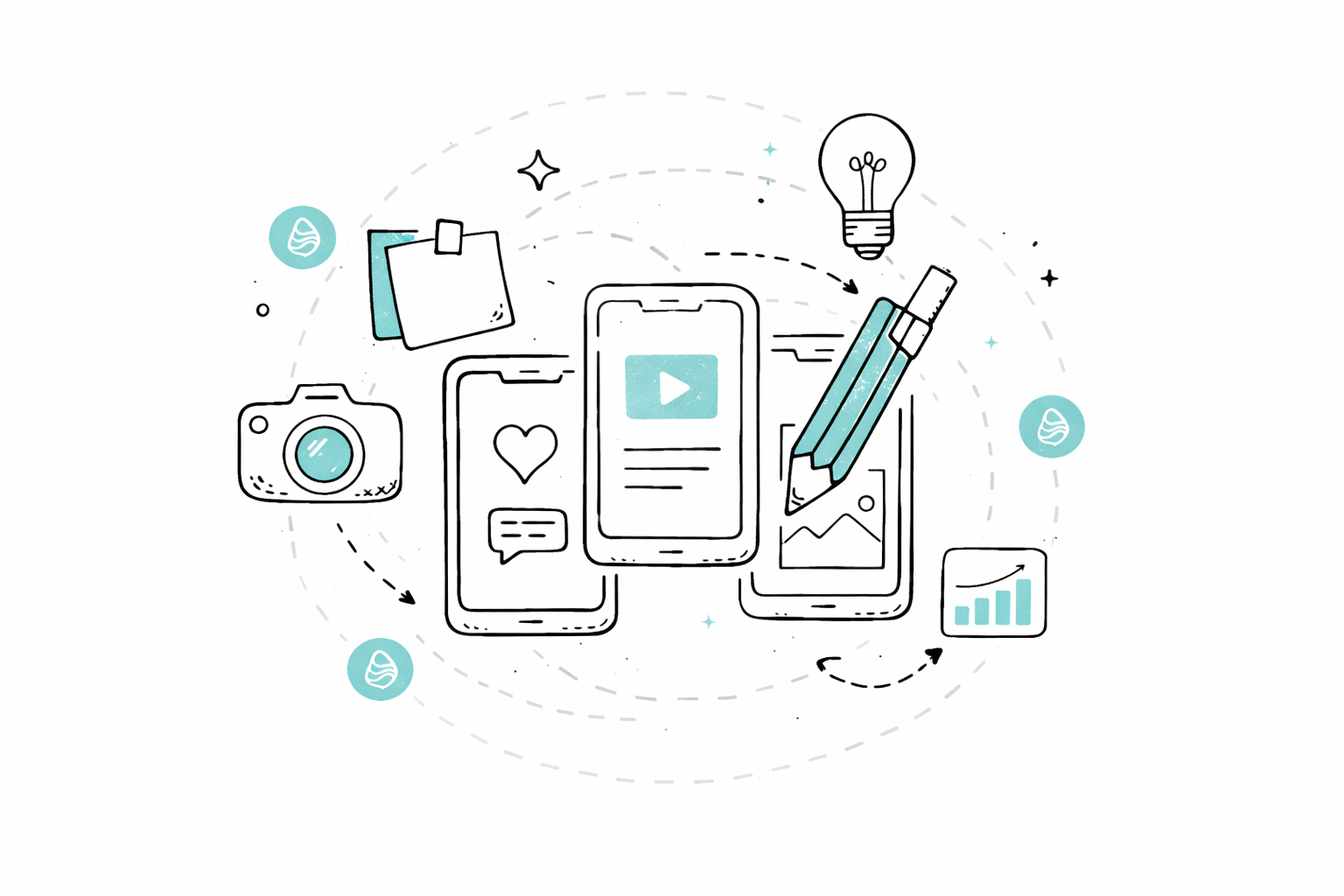
- Mix formats: static images, carousels, short videos (15 seconds or less), and longer explainer videos
- Use different settings, people, and visual styles
- Refresh your creative library every 2-4 weeks for active campaigns
- Watch your CPMs – if they’re climbing, your creative is getting stale
Research from AppsFlyer and industry analysis shows that creative quality now drives 70-80% of Meta ad performance. This is more than targeting, budget, or placement combined.
2. Set Up Conversion API (CAPI) Yesterday
If you are focusing only on the Meta Pixel for tracking, you are missing out on a lot of conversions.
Apple’s iOS new privacy restrictions and ad blockers mean that pixel-only tracking typically captures somewhere between 40-70% of actual conversions, depending on your audience. The remaining other half is not seen by Facebook which means the algorithm can’t optimize properly, and you can’t measure what’s actually working.
Meta’s Conversions API (CAPI) solves this by sending conversion data directly from your server to Meta’s servers, completely bypassing the browser. It’s server-to-server tracking that works regardless of what browsers or privacy settings do.
Why this matters:
- More accurate attribution (you see what’s really converting)
- Better optimization (Meta’s algorithm gets complete data to learn from)
- Improved match quality when you send customer data properly
- Future-proof tracking as browser restrictions get tighter
Here’s what you can do to make sure your tracking isn’t missing out on important data:
- Implement CAPI alongside your Pixel (not instead of it)
- Make sure you’re sending both browser events and server events with proper deduplication
- Include as much customer data as possible (hashed email, phone, address) to improve match quality
- Monitor your Event Match Quality score in Events Manager – aim for 6.0 or higher
- Check that you’re seeing events marked as “Server” or “Server + Browser” in Meta’s Test Events tool
If you’re on Shopify, WooCommerce, or another major platform, there are plugins that make this easier.
3. Simplify Your Facebook Advertising Campaign Structure
In the past, it was beneficial to create separate campaigns for every offer, audience segment, and objective. That approach does not work anymore.
Andromeda needs budget and data to learn. When you break apart your spend across 15 different campaigns, you’re preventing the algorithm from gathering enough data to learn and ultimately, optimize. In other words, data starvation. The algorithm gets stuck in endless learning phases and never actually figures out who to show your ads to.
Here is what works now:
- One campaign per funnel stage (prospecting, retargeting, retention)
- Broader targeting with multiple ad sets only when truly necessary
- Consolidate your budget so each campaign gets enough volume to learn
The brands seeing the best results are running 3-5 total campaigns max, not 20-30.
Here’s how you can simplify your campaign structure and optimize for the best results:
- Audit your account and consolidate redundant campaigns
- Use Dynamic Creative or Flexible Creative features to test variations within a single campaign
- Set campaign budgets at levels that generate at least 50 conversions per week (or per ad set if you’re using multiple)
- Give new campaigns at least 7 days in the learning phase before making changes
- Stop pausing and restarting campaigns based on daily performance—you’re just resetting the learning
If you’re spending less than $1,000/month total, you probably shouldn’t have more than 2-3 campaigns running.
4. Go Broader on Targeting
This goes against what worked really well before, but it’s true: narrow targeting doesn’t work anymore.
Building audience layers like interests, demographics, and behaviors now limit the algorithm’s ability to find your actual customers. Here’s a way to think about it: you could be targeting “women 35-45 interested in yoga” and the algorithm actually finds the best results with men 30-40 who had never shown interest in yoga – but loves the product.
Your creative determines who sees your ad now. Your targeting just sets the outer boundaries.
Here’s how you can go broader with targeting:
- Start with broad targeting (18-65+, all genders, your target countries)
- Use Advantage+ Audience if you want to provide signals without restricting delivery
- Only narrow down if you have clear business reasons (B2B targeting, regional offers, regulatory requirements)
- Let your creative do the work of attracting the right people
- For retargeting, that’s where you can (and should) be specific
The exception here is if you’re in a niche B2B space or have clear geographic limitations, you can narrow. But test broad first. You might be surprised.
5. Make Your Creative Stop the Scroll in 3 Seconds
Unfortunately, people have increasingly smaller attention spans and will scroll past your ads in under 2 seconds unless you give them a reason not to.
Your first 3 seconds need to hook them. Not with clickbait, but with genuine value or curiosity that’s relevant to what you’re selling.
Here’s how you can hook your audience:
- Lead with the benefit, not the feature (“Cut your morning routine in half” not “Our blender has 6 speeds”)
- Use real people over stock photography – authenticity beats polished looks in 2026
- Start videos with movement or a question
- Make the first frame work as a static image (many people won’t play the video)
- Keep text overlays minimal and readable on mobile
Here’s what doesn’t work:
- Talking heads that take 10 seconds to get to the point
- Generic lifestyle photography that could be any brand
- Walls of text
- Anything that looks like an obvious ad
User-generated content (UGC) is absolutely dominating right now. Ads that look like they were made by real customers, not professional studios, are outperforming polished brand content. People are tired of being sold to by machines. They respond to stuff that feels human.
6. Use Advantage+ Shopping Campaigns (If You’re E-Commerce)
If you sell products online you should be leveraging Advantage+ Shopping Campaigns (ASC). Otherwise, you’re leaving money on the table.
ASC is Meta’s fully automated campaign type that combines prospecting and retargeting in one campaign. It sounds scary to hand over that much control, but the results speak for themselves. Businesses using Meta’s Advantage+ Shopping campaigns have reported 22% better performance than those using manual targeting.
Here’s why it works so well:
- The algorithm can shift budget between prospecting and retargeting automatically based on what’s working
- It has access to more placement options and can optimize across all of them
- It leverages your product catalog plus your creative
- Less manual work for you
Here’s how you can make the most of ASC:
- Make sure your product catalog is up to date and properly set up
- Add 3-5 strong creative ads to complement your catalog
- Give it at least $50-100/day in budget to perform well
- Let it run for 14 days minimum before judging results
- Compare it against your manual campaigns, not your expectations
Keep in mind that not every business should use ASC (it’s built for e-commerce), but if you sell products, you should very well test it.
7. Track What Actually Matters (Not What’s Easy)
Another important consideration for effective Facebook advertising is making sure you’re tracking metrics that actually tell you if your ads are generating profitable revenue..
CPMs, CTRs, and engagement rates are interesting, but they are mostly vanity metrics. What matters is tracking metrics that tie to business results, not just ad platform dashboards.
Here are the metrics that actually matter:
- Blended CAC (total ad spend ÷ total new customers)
- Marketing Efficiency Ratio (MER) = total revenue ÷ total ad spend
- New customer rate (what % of conversions are actually new vs. repeat)
- Customer Lifetime Value by acquisition channel
Here’s what to track in-platform:
- Cost per desired outcome (purchase, lead, add-to-cart)
- Conversion rate
- Impression share (for search campaigns)
- Creative fatigue scores (new in 2026)
But don’t let platforms trick you into thinking their attribution is the end-all-be-all. Meta will claim credit for conversions, Google will claim credit for the same conversions, and the truth is usually somewhere in between. Use your MER as a reality check – it tells you if your total marketing spend is profitable, regardless of who gets credit.
8. Build Retention Campaigns (Not Just Acquisition)
Lastly, the cherry on top that could actually help you make the most money: stop abandoning customers after they buy.
A lot of advertisers set up prospecting campaigns, maybe some retargeting, and call it done after that. But your existing customers are 5-10x more likely to convert than cold prospects, and they spend more when they do.
Here’s how you can start building retention campaigns:
- Create a custom audience of people who purchased in the last 60-180 days
- Run campaigns specifically to this audience with:
- New product launches
- Complementary products based on what they bought
- Seasonal offers
- Restocking reminders (for consumables)
- Keep frequency under 2-3 impressions per week to avoid annoying them
- Track repeat purchase rate and customer lifetime value
By prioritizing retention campaigns, you shift your focus from constant new acquisition to nurturing your most valuable asset, your existing customer base, which is the most effective path to increased lifetime value and long-term profitability.
Why This Matters More Than You Think
Facebook advertising isn’t getting easier. The platform is moving toward full automation, which means the advertisers who win are the ones who understand how to work with and adapt to the algorithm.
That means feeding it diverse creatives, giving it clean conversion data, trusting it to find your customers instead of trying to manually specify every detail, and measuring results based on business outcomes, not vanity metrics.
Facebook ads still work. They are still one of the highest-ROI channels for most businesses. But only if you’re playing by the current rules, not the old ones.
What’s your biggest challenge with Facebook ads right now? Are you seeing costs climb, or are you just not sure where to start with all these changes?
About the Author: Grace Wong